
Today, let’s learn how to create restaurant website mockups so that next time you want one, you’ll be able to easily visualize your idea in a snap.
While will you even want one?
Well, before you commit to creating a full blown site, you might need to first see how things are going to appear first.
Restaurant website mockups help you create a visual representation of your desired website with everything in place to give you or others an idea of what the real website is going to look like.
In this guide, I’ll be showing you how they look like and how to create pro restaurant website mockups.
Here’s what we’ll cover:
- The main features of restaurant website mockups and how they are used
- Top tools used in creating
- The main process to build your own
So if you’re ready to plate up a site that pulls in reservations, let’s begin with a mockup before we get interractive.
1) Master the Main Features of Restaurant Website Mockups?
From the introduction, you might already have an idea of what we are talking about, when we say mockups.
But let me illustrate for you, just that you get an idea of what you are creating.
You see that time you’re sketching ideas on a napkin during downtime, that’s the spark.
But restaurant website mockups take it further.

They’re visual blueprints of your site, from rough outlines to polished previews.
Think wireframes showing page flow or high-fidelity designs with your actual photos and fonts plugged in.
What do Restaurant Website Mockups Look Like?
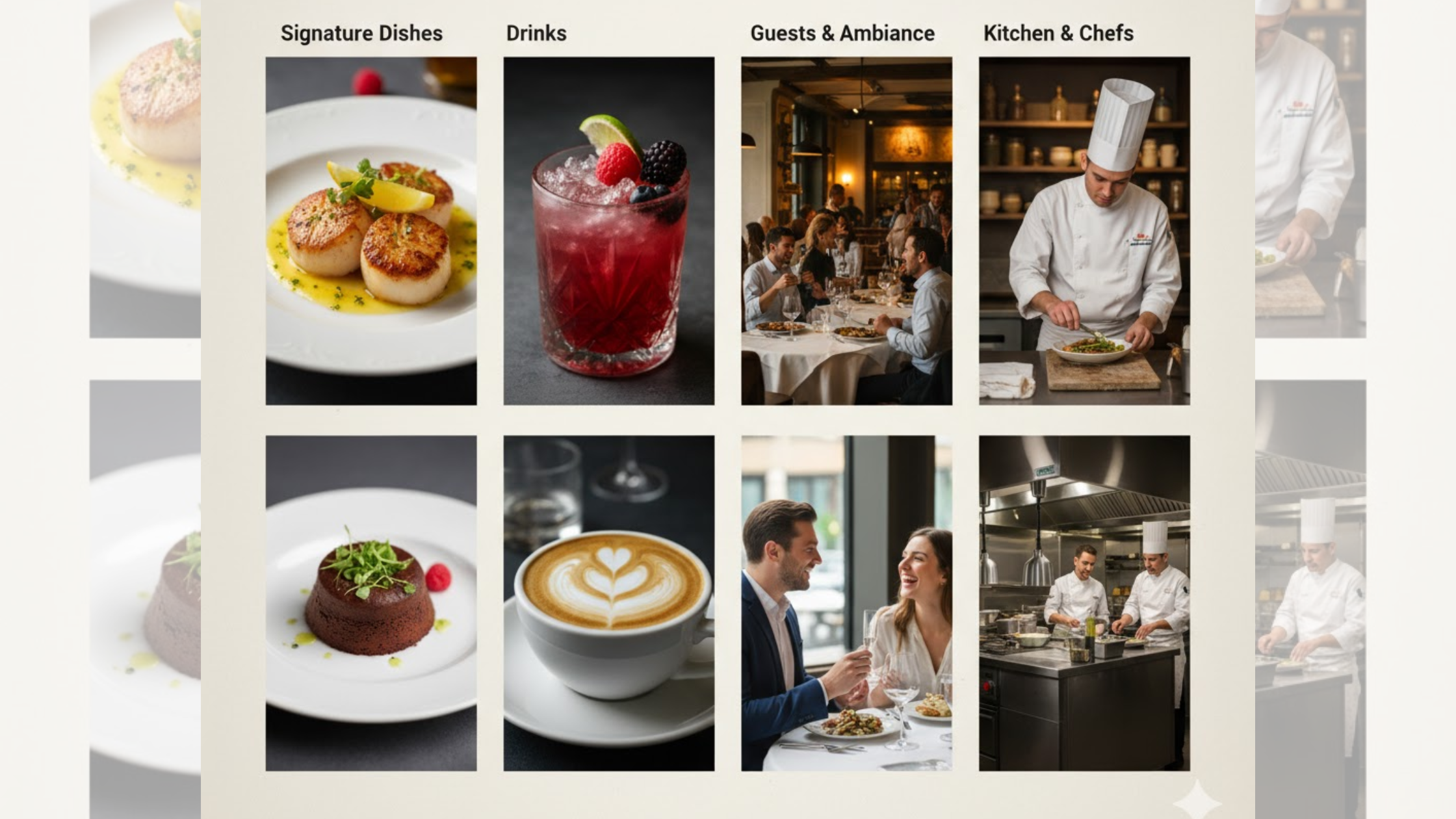
A mockup is basically a polished, static preview, almost like a screenshot of a website that doesn’t exist yet.
No code, no buttons that actually work, just a fully rendered visual design that shows exactly how everything will look once it’s built.
So, what does that typically include?
a) High-Quality Food Photography:
This is the star of the show for any restaurant site.
So, restaurant mockups almost always feature big, mouth-watering photos of signature dishes, cocktails, even interior shots.
The goal is simple: make the viewer hungry and get them interested right away.
b) Strong, Consistent Branding:
You’ll see the restaurant’s colors, logo, and fonts woven into every part of the design.
A fine-dining steakhouse might have darker, richer tones, while a cozy café may lean toward warm, inviting colors.
The mockup sets the mood just as much as it shows the layout.
c) Clear, Easy Navigation:
Restaurant websites are all about helping visitors take action quickly.
That’s why mockups highlight things like:
- Menu (often right on the homepage)
- Reservations / Book a Table (usually the main call-to-action)
- Online Ordering / Takeout (if the restaurant offers it)
- Location and Hours (often in the footer or its own section)
Everything is laid out so that a user can find what they need in seconds.
d) Structured, Thoughtful Layout:
Mockups also show where key sections will live on each page.
Things like “Our Story,” “Gallery,” upcoming events, or testimonials.
It’s essentially the blueprint of your content.
e) Responsive Views:

A good mockup doesn’t stop at the desktop version.
It also shows how the website will look on tablets and mobile phones.
The goal is to make sure crucial features like the reservation button remain just as easy to access on smaller screens.
When Are Restaurant Website Mockups Used?
You’ll mostly be using mockups in the middle of the website creation process, after planning and wireframes, but before beginning to code.
a) Getting Approval
This is when the restaurant owner reviews the design and gives feedback.
It’s easy to swap photos, adjust colors, or tweak layout details before developers start building, which saves time and money.
b) Improving the User Experience
Mockups help confirm that the layout feels natural, guiding the visitor from eye-catching photos to key actions like booking a table or ordering online.
c) Guiding the Developers
Once approved, the mockup becomes the visual blueprint for the development team, showing exact colors, fonts, spacing, and button styles so the final site matches the design perfectly.
d) AI-Assisted Design
In cases where you’re using an AI site builder, you can use AI to create fast design drafts, then compare them to your mockup.
If the AI veers off—wrong colors, wrong vibe—you simply refine the prompt until it matches what you approved.
Also, AI can generate multiple versions of a page for A/B testing.
So, you can review these mockups first, choose your favorites, and only test the best options with real users.
In short, the mockup makes sure everything the AI produces stays consistent with the restaurant’s approved look and feel.
2) Select the Right Tools for Building Your Restaurant Website Mockups
You only need something intuitive to create a mockup.
1. Canva
Canva is the easiest place to start.
Just grab a restaurant template, drop in your photos and logo, and you’ll have a clean mockup in under an hour.
It’s beginner-friendly and packed with great stock images, though it’s mainly for simple, static previews.
The free version is solid, and Pro is affordable if you want extra features.
2. Figma
If you want a bit more control, Figma is your go-to.
It’s collaborative, great for teams, and loaded with plugins for menus, maps, and layouts.
It takes a few minutes to get used to, but once you do, it’s incredibly flexible.
3. Adobe XD
For polished, high-end visuals, Adobe XD gives you that extra shine, especially if you’re pairing it with Photoshop for food photography.
Just note that it’s paid and more desktop-focused.
4. AI Tools
Lastly, there’s the modern option: AI tools like Olitt AI.
Instead of dragging elements around, you can just describe your restaurant’s vibe and get a complete mockup in minutes.
It’s fast, mobile-optimized, and great if you want to move straight from idea to full site.
The trade-off? Less control over every pixel.
3) Build the Pro Restaurant Website Mockups
Now, it’s time to build.
This walkthrough assumes you’re hands-on but smart about time.
So, we’ll blend manual steps with an AI fast-track using Olitt—because who has all day?
i. Start With Your Goals
Before you design anything, think: What do I want this website to actually do?
Is it about getting more reservations? More takeout orders? Or telling your brand story?
Keep it to three main goals so you stay focused.
For example, a sushi spot like Mujō Atlanta might aim for:
“Calm, minimalist pages with big photography that feels zen.”
ii. Sketch the Structure (Wireframe It)
Grab a paper or Canva’s basics. Map out your core pages:

- Home: Hero image + strong call-to-action
- Menu: Clear categories
- About: Story + team
- Contact: Map + form
Keep mobile users in mind first. Stack elements vertically and stick to 5–7 navigation items. Nobody wants to dig through a maze to find “Catering.”
iii. Add Your Branding
Now bring in your vibe, colors, logo, fonts, and textures.
Think: warm terracotta for an Italian restaurant, cool ocean blues for seafood.
Tools like Figma let you drop in exact brand colors.
iv. Bring in the Restaurant Magic
This is where your site comes alive.
- Hero section: A gorgeous dish with text like “Table for two? Book now.”
- Menu: Simple accordions for categories.
- Gallery: Golden-hour photos of your space.
- Reservations: Big, unmistakable buttons.
And don’t forget accessibility—add alt text like “Grilled octopus special.”
v. Test the Experience
Click through like a real visitor. Does a burger lover get to the beef section fast? Does anything feel confusing?
Share it with a friend or your line cook, they’ll notice things you missed.
vi. Polish and Iterate
Add small touches like hover fades, cleaner spacing, or sharper photos.
Export a PDF or interactive preview, and if something feels off, loop back and adjust.
vii. Or… Use the AI Shortcut With Olitt
If you’re buried in prep lists, here’s the faster route.
Go to olitt.com, create a free account, then head to olitt.com and select Restaurant AI Website.
Hit “Build with AI.”
The AI will ask simple questions—your restaurant name, cuisine (“cozy vegan café”), vibe (“family-friendly or hipster?”), and goals (“boost online orders?”).
It will then summarize everything, then if you like it, you hit Create My Website.
Choose a plan:
- Free – basic features
- Starter ($9.99/mo) – custom domains
- Pro ($10.99/mo) – stronger SEO
- Business ($29.99/mo) – e-commerce menus
After that, Olitt builds the whole site mockup, with sections, layout, menus, and images, within minutes.

You can scroll through it, tweak text or photos, or even tell the AI things like:
“Make the hero image warmer.”
Whenever you are satisfied with the mockup, you can add links, and domain to publish a fully interactive site.
FAQ
How long does it take to get a mockup with AI?
With Olitt, just a few minutes—seriously. You’ll get a full site to preview, too. Doing it manually? Expect anywhere from a few hours to a couple of days.
Are free tools enough when I’m just starting out?
For sure. Canva covers the basics beautifully. You can always upgrade later if you need more flexibility or team features.
Does SEO matter at the mockup stage?
A little, yes. It helps to plan your key phrases early especially for headings and image alt text. It saves you cleanup later.
Can I customize things after the AI builds my site?
Absolutely. Olitt’s editor lets you tweak everything and you can even ask the AI to make changes for you anytime.
Wrapping It Up
So that’s the blueprint to craft restaurant website mockups that dictate great sites.
From wireframe basics to AI zips, you’ve got paths for every pace.
Olitt AI delivers a pro restaurant website mockup baked into a full, live site.
Curious? Swing by https://olitt.com/restaurant/ for a free trial.
Input your spot’s story, pick Starter for under $10/month, and see your vision launch in minutes.
Your site’s story waits. Make it perfect with the guidance of a mockup.