
With most diners today deciding in seconds whether to click “book” or swipe away, having some reputable restaurant website examples can come in handy.
I mean, as a restaurant owner, you are definitely hustling through the daily grind, sourcing ingredients, training staff, or chasing reservations.
So, your website needs to match up to that and bring in the clients.
In most cases, to come up with a great lead generating website, calls for hiring a designer.
Now, that’s an expense you don’t need.
The best alternative would be borrowing some ideas from others out there who have made it and evidently headed the same direction you want to.
This guide compiles for you the top restaurant website examples that are killing it in 2025, and the features that make them tick to give you an idea of what you should be doing.
Here’s what we’re covering:
- The must-have elements that make restaurant sites convert in 2025
- 10 handpicked restaurant website examples
- Step-by-step on recreating them with Olitt AI
Now, let’s turn those empty seats into sold-out nights.
What Makes a Restaurant Website Stand Out in 2025?
Well, with most of us glued to mobiles every hour, it only tell you that poeple are mostly going to look online first, whenerver they need food.
And as all of us to presumably, they’ll be be looking for your website, and not on socials.
That means your website has to be on point and very welcoming, enough that they can find it fast and want to look more and buy.
So, since we already have a few of these top restaurant website examples, what really elevates them from good to unforgettable?
1) Mobile-First Magic: Everything scales flawlessly, meaning no pinching to zoom on your menu.
Here, prioritize thumb-friendly navigation, to get more engagement on phones.
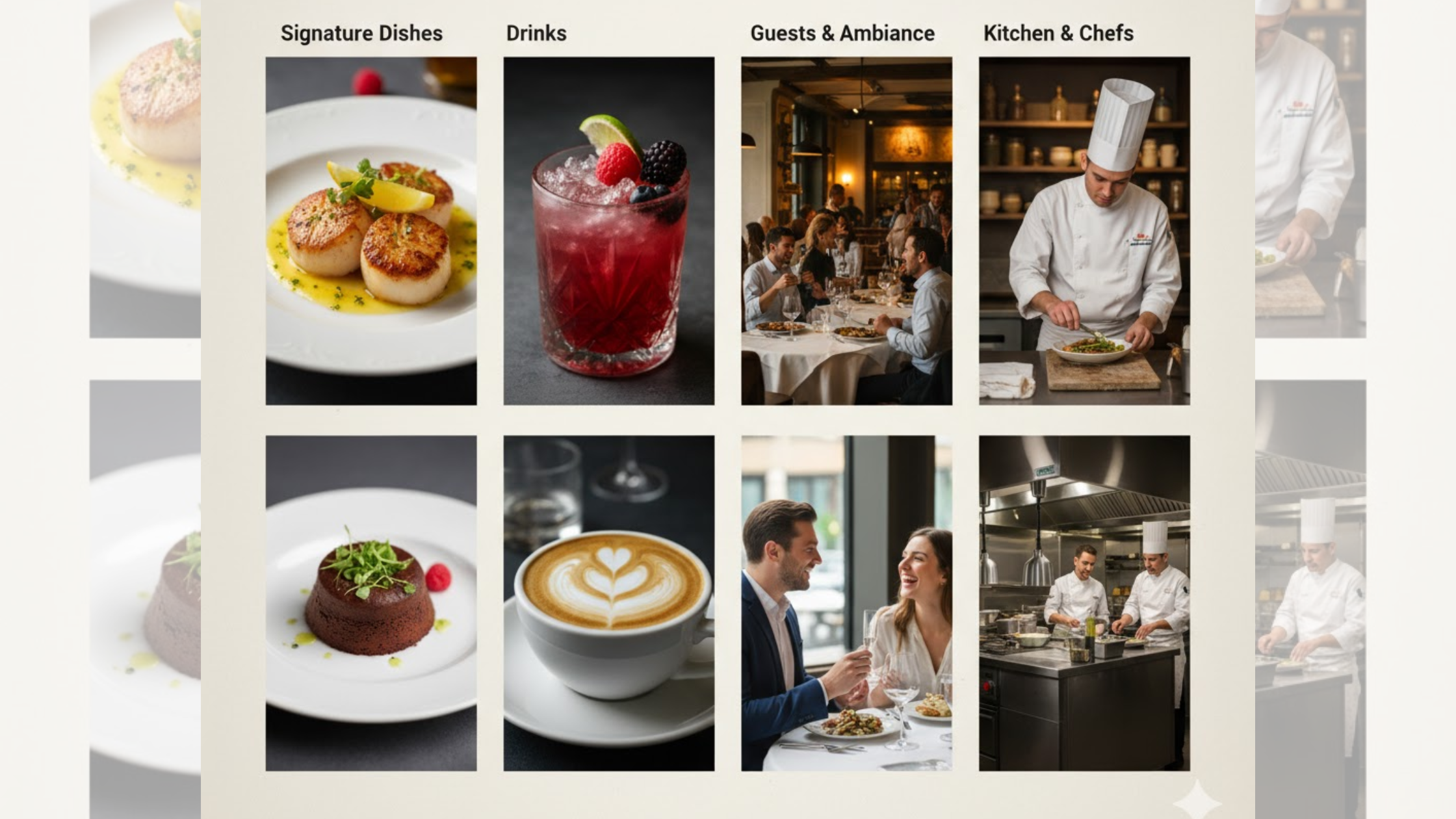
2) Visual Storytelling: High-res images and subtle videos evoke hunger and trust. Pair them with alt text for SEO, so Google loves you too.
3) Frictionless Bookings and Orders: Bold CTAs like “Reserve Now” or “Order Takeout” lead straight to integrations (think OpenTable or your POS).
No forms that feel like tax season.
4) AI-Powered Personalization: This one suggests dishes to your clients based on their past visits or location.
It’s subtle magic that boosts repeat business big time.
Sustainability badges or allergen filters add that thoughtful touch.
5) SEO and Accessibility Smarts: Local keywords, schema markup for rich snippets, and voice-search friendly layouts ensure you’re found when someone Googles “best pasta near me.”
These ideas are pulled from top-performing restaurant website examples that drive real results.
Nail them, and your site becomes an extension of your hospitality, welcoming, efficient, and impossible to forget.
Ready to see them in action?
Top 10 Restaurant Website Examples to Emulate in 2025
Drawing from the cream of the crop in 2025, these restaurant website examples span fine dining haunts to casual gems.
Let’s feast on the inspiration.
1. Noma (noma.dk)
Noma, is a Copenhagen fine-dining icon led by chef René Redzepi.
It sets the bar for thoughtful restraint.
Its site opens with serene, seasonal imagery, think Nordic forests morphing into dish close-ups, that evolves with the menu’s foraging theme.
Navigation has a single-page scroll to reservations, offers, and people and events pages, all in a clean sans-serif font against white space.

No clutter; just elegant CTAs that feel exclusive.
What to emulate?
Lately, diners crave authenticity amid fast-food fatigue.
Noma, subtlety builds anticipation without overwhelming, perfect for high-end spots aiming for that “event” vibe.
UX tip: Use subtle animations for image transitions to guide eyes without distracting to cut bounce rate by keeping users immersed.
With Olitt AI, you can mimic this ethereal flow so easily.
Just input your story, and it generates minimalist layouts with rotating hero images tailored to your cuisine.
2. Shake Shack (shakeshack.com)
Shake Shack, the NYC-born burger empire now global, nails approachable energy.
Black-and-white backdrops pop with green accents, framing drool-worthy photos of ShackBurgers and crinkle fries right on the homepage.
Menus expand accordion-style for easy scanning, with allergen filters and “Find a Shack” geo-locator for instant relevance.
Booking? Perfect links to app orders or in-store pickups.
Emulate for its efficiency, ideal for busy chains where speed trumps flash.
In a year of hybrid dining, this setup funnels traffic to sales, boosting online orders magically.
UX hack: Embed location-based menus; it personalizes without AI overload, keeping load times snappy.
Olitt AI shines here too.

Feed it your menu items and locations, and it auto-builds interactive sections with filters.
3. Forage (eatforage.com)
Forage, a Madison, WI, haven for plant-powered bowls, wears its eco-heart on its sleeve.
Vibrant, original photos of heirloom grains and house kombucha dominate, paired with clear headings that trace farm sources.
CTAs scream “Order Now” in earthy tones, linking to seamless online platforms, while a sustainability badge highlights zero-waste practices.
This website example is gold for health-focused niches.
Its transparency fosters trust, driving more loyalty sign-ups in green-leaning markets.
Copy the story-driven visuals to connect emotionally—diners eat with their values now.
Pro tip: Integrate Instagram feeds for fresh, user-gen content that feels alive.
Olitt AI’s AI personalization lets you input farm stories and specialties, spitting out eco-themed pages with badge integrations.
4. Meals by Genet (mealsbygenetla.com)
Chef Genet Agonafer’s LA Ethiopian gem welcomes with sun-kissed interiors and spice-market aromas via immersive gallery shots.
Bold “Our Menu” leads to categorized menus (injera-focused, naturally).

Emulate this one for its cultural intimacy.
It’s perfect for ethnic spots building community in diverse 2025 cities.
It humanizes the brand, lifting repeat visits by evoking home feeling.
UX essential: Personal touches like chef bios keep scrolls engaging; avoid walls of text.
When using Olitt AI to build, describe your heritage and dishes, and craft story sections with testimonial slots.
5. Sketch London (sketch.london)
This London pink-hued paradise by Michelin-starred Pierre Gagnaire turns browsing into playtime.
3D room tours let you “explore” Gallery or Parlor via interactive avatars, with animations unveiling emoji menus and podcast embeds.
Reservations pop mid-scroll, blending whimsy with utility in a pastel palette.
Why copy?
For experiential dining, it previews the magic, converting curiosity to bookings.
In VR-curious 2025, it’s forward without gimmicks.
Tip: Gamify navigation sparingly; overdo it, and it fatigues.
With Olitt AI input room themes, and it generates animated previews.

6. Mei Mei Street Kitchen (meimeidumplings.com)
Boston’s sibling-run dumpling den shares its scrappy origins through bloggy “Our Story” pages, recipe shares, and sustainable sourcing spotlights.
Clean lines frame dumpling close-ups, with online ordering buttons everywhere and a community events calendar.
This example thrives on relatability for family ops, since its content depth SEO-boosts local searches, drawing more traffic.
You can emulate the behind-scenes to build superfans.
UX win: Recipe teases as lead magnets for emails.
With Olitt AI, upload family pics and values; it weaves them into narrative flows.
7. Farmacy (farmacylondon.com)
London’s plant-based pioneer traces every kale leaf from soil to plate via sequential photo essays.
Bright, verdant visuals pair with crisp allergen menus and “Farm Visit” CTAs, all in a soothing green scheme that’s mobile-bliss.
Sustainability sells here, so you can emulate for niche appeal, as eco-sites retain more customers.
It educates without preaching.
Tip: Chain visuals to your supply chain for authenticity.
8. Ottavio’s Italian Restaurant (ottavio.com)
This family Italian staple in Texas glows with the physical restaurant image and servings, elegant nav to dedicated menu pages (gluten-free stars), and a map with satellite view.

Online ordering hums perfectly, with SEO-rich location tags.
Copy for timeless appeal, its polish converts browsers to bookers, especially with reviews building cred.
UX: Segment menus by diet for inclusivity.
Olitt AI’s builder imports reviews and menus, crafting polished pages.
9. The Lost Kitchen (findthelostkitchen.com)
Erin French’s Maine hideaway keeps it raw.
Muted bucolic shots frame the chef’s face, with lottery-style reservations and cookbook teases on soft off-whites.
It’s just simple and soulful.
Emulate for boutique intimacy as it fosters FOMO, filling seats seasonally.
For AI builder, share your chef’s journey and get bespoke layouts.
10. Beefbar (beefbar.com)
Global steak sensation Beefbar struts with black-and-white luxe, high-res cuts scrolling smoothly to merch and reservation hubs.
Typography screams sophistication, with venue switchers for multi-loc ops.

For upscale chains, it’s aspirational—driving premium bookings via exclusivity.
Emulate the polish for perceived value.
UX: Smooth scrolls keep high-end energy flowing.
These restaurant website examples prove: Great design is about pulling people closer to your table.
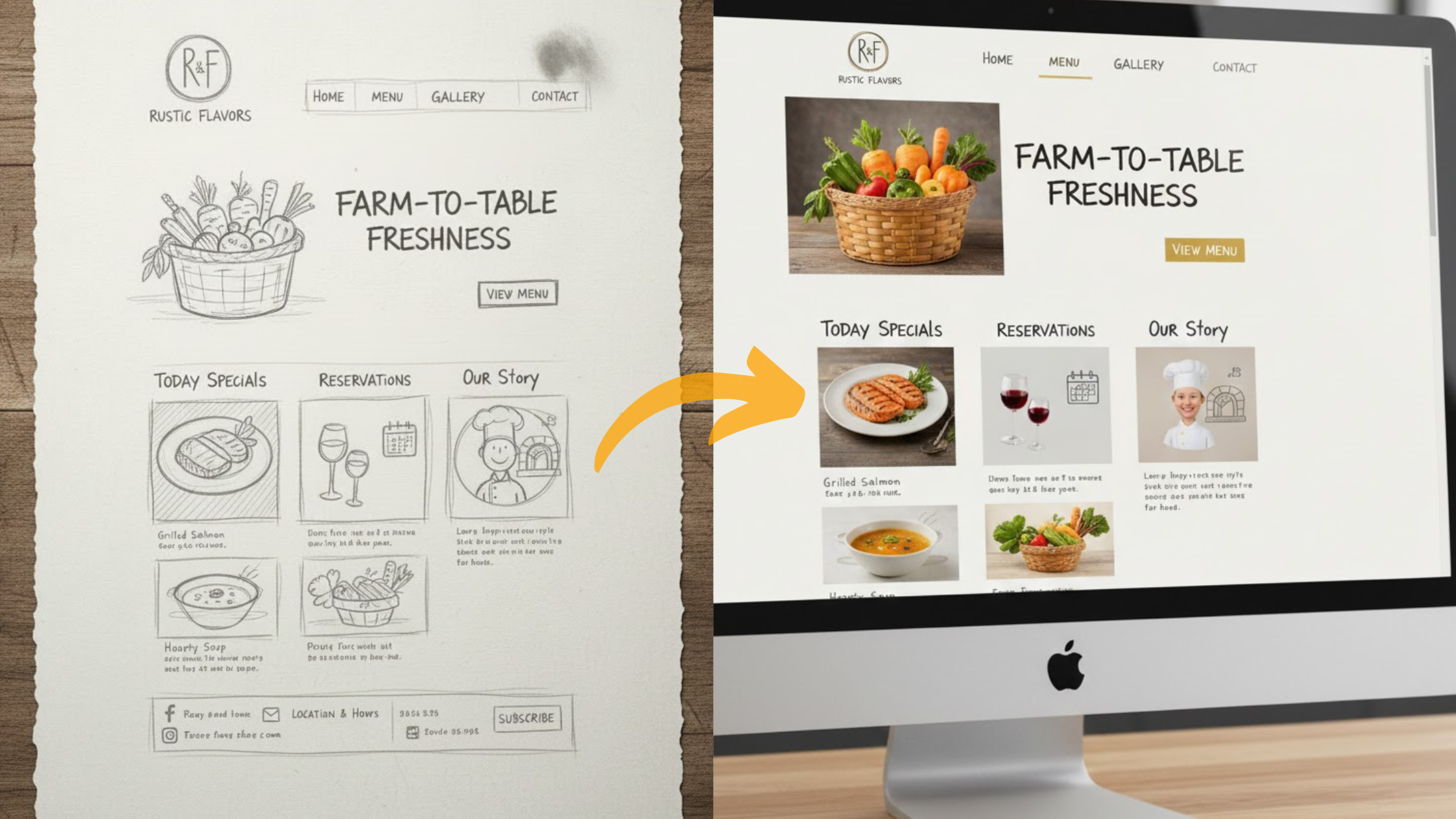
How to Emulate These Restaurant Website Examples with AI
You’ve ogled the inspirations, now, how do you make them blend with your brand?
1. Sign Up and Spark the AI:
Head to olitt’s website and create a free account.
Go back to the website and on the navigation menu, hoover over the AI websites option.
Click on the “Restaurant AI Website,” then the “Build with AI” button.
Alternatively, on your dashboard, hit “Create with AI.”
Pour in the essentials: your biz name (e.g., EatOuts Restaurant), mission (“Bringing farm-fresh flavors to busy families”), and backstory (that family recipe origin tale).
2. Paint Your Picture:
Detail your ideal customers (local foodies, 30-50s) and services (book a table, view menu, order takeouts, join newsletter).
Also enter your preferred colors (warm earth tones) and visual style (rustic chic).
Enter your address, hours, booking prefs (online or click-to-call), and a tagline (“Savor the Simple”) as well.
Last and not least, specify your signature dishes (grandma’s lasagna), delivery/pickup options, and testimonials.
3. Review and Launch:
Hit submit, and voilà—a preview page recaps everything.
Click “Create My Website.”
Next, pick your plan: Free for basics, Starter at $9.99/month or $19/year, Pro at $10.99/month or $49/year, or Business at $29.99/month or $199/year.
Update billing, and the AI gets to work.
4. Tweak and Go Live:
In minutes, your site’s ready—open it, connect domains, and start driving traffic.
Edit anytime with drag-and-drop features.
This whole process can borrow ideas from those top restaurant website examples.
Conclusion
These restaurant website examples show 2025’s winners blend heart, smarts, and a dash of tech to keep tables turning.
You’ve got the breakdowns, the why’s, and now the how with Olitt AI.
It’s all about infusing your soul into a site that works as hard as you do.
Why wait for tomorrow’s empty night?
Your diners are out there, hungry for what only you serve.
Fire up Olitt AI, drop in your details, and watch your dream site bloom in minutes.