
.org vs .com vs .net Domain: The three extensions started with different jobs: .com was built for commercial sites, .org for organizations and causes, and .net for networks and tech services.
Today anyone can register any of them, so the real difference is what visitors assume about your site the moment they see the address.
This guide compares all three side by side, with fresh 2026 numbers, real pricing, and a simple way to decide before you pay for anything.
The Quick Answer
If you are in a hurry, this table points you in the right direction.
| If You Are Building | Start With | Why |
| A business, online shop, or personal brand | .com | Most familiar and easiest to remember |
| A nonprofit, church, club, or community project | .org | Signals mission over sales |
| A hosting, networking, or developer tool | .net | Fits technical services naturally |
| A project where your .com name is taken | .net or .org | Often easier to find a clean name |
| A business that mainly serves Kenyan customers | .co.ke | Strong local signal |
The rest of this guide explains why each one lands where it does.
First-Glance Test
Take one name, Tumaini Hosting, and read it with each ending. Say each one out loud, as if you were telling a friend.
- tumainihosting.com sounds like a company selling hosting plans
- tumainihosting.net sounds like a technical service, which matches what hosting actually is
- tumainihosting.org sounds like a charity that helps people get online
Same name, three different promises. The .net version fits best here, and the .org version would confuse anyone expecting a paid service.
That small test is the fastest way to catch a mismatch before you register anything.
What Is a .com Domain?
The .com extension stands for commercial, and it remains the default address people expect on the internet.
As of June 30, 2026, the .com domain base totaled 166.6 million registrations, according to the DNIB Q2 2026 report from Verisign, the company that runs both .com and .net.
That scale brings real benefits.
- Visitors trust it instantly and type it by habit
- It works for almost any kind of website
- It leaves room to grow into new products or markets
It also brings a real drawback. Decades of registrations mean most short, simple names are already taken.
What Is a .org Domain?
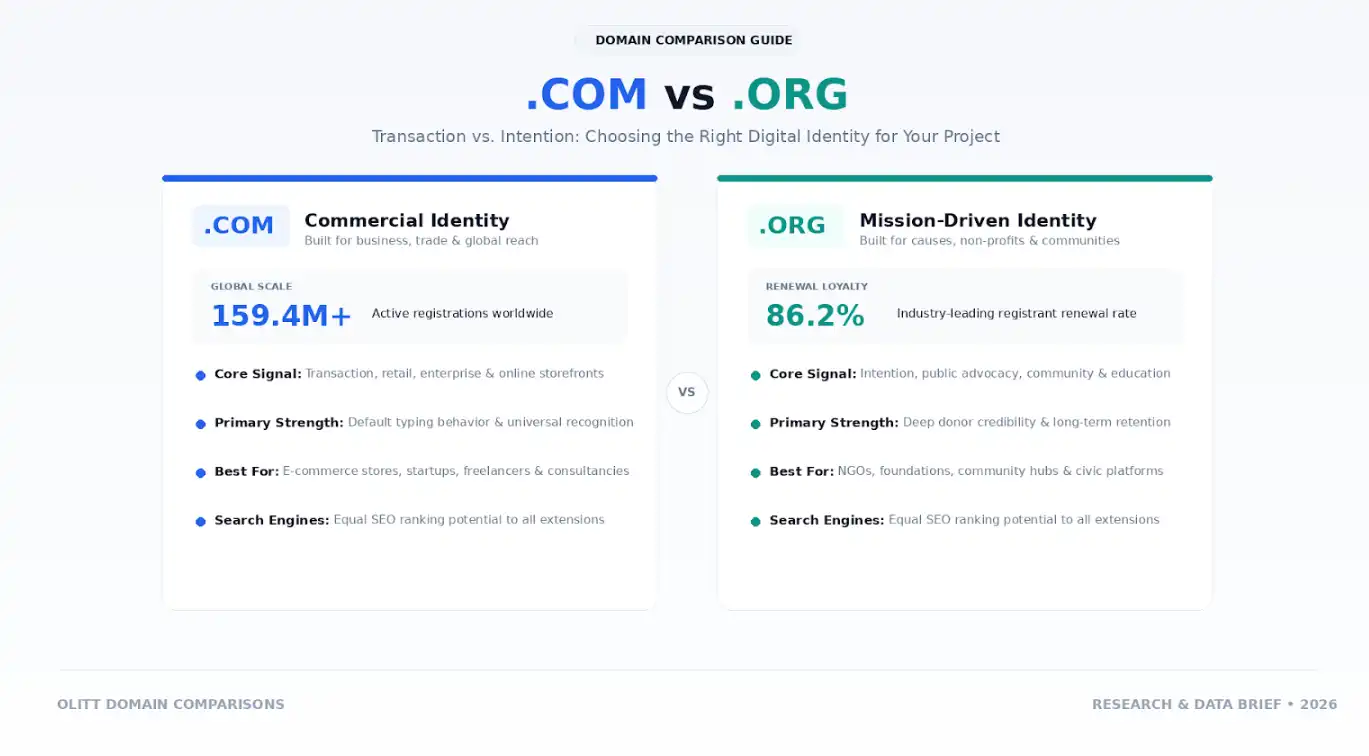
The .org extension stands for organization, and it has long been tied to nonprofits, schools, and community groups.
It is run by the Public Interest Registry, a nonprofit, and anyone can register one without proving nonprofit status.
That openness does not change how visitors read it. Many people still assume a .org site exists for a cause, so a business using it should make its commercial purpose clear right away.
The upside is real too.
- It builds trust fast for mission-led projects
- Clean names are often easier to find than on .com
- It suits associations, foundations, and open-source communities
For a deeper look at this head-to-head, our guide to the .org vs .com domain goes into the loyalty data and the psychology behind each ending.
What Is a .net Domain?
The .net extension stands for network, and it was first meant for internet service providers and infrastructure companies.
The Q2 2026 data shows the .net base at 12.5 million registrations, which makes it the fourth largest extension in the world, ahead of .org.
Today it works best for technical products such as hosting, APIs, developer tools, and online platforms. Our full guide to what a .net domain is covers its history and best uses in more detail.
Outside tech, .net can feel like a backup choice. Your brand name has to carry more of the weight.
One warning applies here. Check who owns the matching .com name. If that business works in your industry, some of your visitors will end up on their site instead of yours.
.org vs .com vs .net: Full Comparison
Here is everything in one place.
| Factor | .com | .org | .net |
| Original meaning | Commercial | Organization | Network |
| Best for | Businesses, shops, brands | Causes, communities, associations | Tech, hosting, platforms |
| Registrations (June 2026) | 166.6 million | Fifth largest extension worldwide | 12.5 million |
| Visitor assumption | Selling something | Mission or community | Technical service |
| Name availability | Hardest to find | Easier | Easier |
| Trust level | Highest familiarity | High for causes | Moderate, strong in tech |
| SEO effect | None on its own | None on its own | None on its own |
| Typical Olitt starting price | About 5.99 dollars per year | About 12 dollars per year | About 13 dollars per year |
Prices change with promotions, so always confirm the registration and renewal amounts at checkout before you pay.
Does the Extension Affect SEO?
No. This is one of the most common worries, and also one of the easiest to settle.
Google has said through public guidance, covered by Search Engine Land, that generic extensions are treated alike when it comes to ranking.
Your content, site speed, mobile experience, and backlinks decide your position in search. The three letters after the dot do not.
Where the extension does help is trust and clicks. A familiar ending can make a visitor more comfortable clicking your result, which supports your traffic indirectly.
The Phone Keyboard Factor
A small detail that rarely appears in comparisons is how people type your address on a phone.
On many phone keyboards, .com sits on its own key, while .org and .net hide behind a long press. It is a tiny extra step, but it adds up for mobile-first audiences.
This is not a reason to avoid .org or .net. It is a reason to keep your domain short and easy to share, and to say the full address clearly in ads, posters, and voice notes.
Where .co.ke Fits Among the Three
If your customers live mainly in Kenya, a local extension deserves a spot in the comparison.
The .co.ke ending tells Kenyan visitors and search engines that your business is local. It is also priced low, with Olitt listing it from about 2.30 dollars per year.
A common setup is a .co.ke as the main address for local trade, with a .com or .org added later if the brand grows beyond Kenya. Our guide to Kenya’s domain extensions shows how .co.ke, .or.ke, and .ke compare.
Should You Register More Than One?
Often, yes. Owning the extra endings protects your brand from copycats and catches visitors who guess the wrong one.
You do not need three websites. Register the extras and redirect them to your main address, so example.org and example.net both land on example.com.
Here is what that costs at the starting prices above.
| Domain | Approximate First-Year Price |
| .com | 5.99 dollars |
| .org | 12 dollars |
| .net | 13 dollars |
| All three together | About 31 dollars |
For a business that depends on its name, that is a small price for blocking a competitor from sitting on a lookalike address.
Common Mistakes When Choosing
A few errors repeat across almost every project.
Using .org to look more trustworthy. A store on .org can feel oddly out of place, and trust has to come from your content, not your ending.
Picking .net without checking the .com owner. If a rival holds the .com, your visitors may leave without ever finding you.
Choosing the extension before the name. A clear, short name on a plain ending beats a clever name that nobody can spell.
Skipping renewal reminders. Whichever one you pick, an expired domain takes your website and email down with it.
Pick in 60 Seconds
Run through these four steps and you will have an answer.
- Write one sentence describing your website
- Match its first words to the table at the top of this guide
- Say the full address out loud and listen for a mismatch
- Check the same name on the other two endings before you pay
If all three are open and your budget allows, register all three and redirect them.
Register Your Domain With Olitt
Whichever ending you choose, the process through Olitt is the same.
- Search your name and check all three endings together
- Compare the registration and renewal prices
- Add your pick, or all three, to your cart
- Pay and let the DNS settings configure automatically
- Connect the domain to a site built with the Olitt AI website builder
Start your search on Olitt’s domain page and lock in your name before someone else does.
Frequently Asked Questions
Which is better, .org, .com, or .net? None is better overall. .com suits businesses, .org suits causes and communities, and .net suits technical services.
Can a business use a .org or .net domain? Yes. All three are open to everyone, though visitors read each ending differently, so pick the one that fits your purpose.
Does .com help my website rank higher on Google? No. Google treats these extensions alike for ranking, and your content and backlinks decide your position.
Is .net a good backup when my .com is taken? Yes, if the .com owner is not in your industry. Otherwise visitors may confuse the two sites.
Should I buy all three extensions? It is a smart move if your budget allows. Register the extras and redirect them to your main domain to protect your brand.