
If you own a local business or help people with their marketing, you probably spend a lot of time working on Google Business Profiles, replying to reviews, and trying to show up in local searches.
But after all that work, how do you know if it is working? That is what local seo reporting covers.
Local SEO reporting is simply checking your numbers to see what happened over the past week or month.
It tells you whether more people found your business on Google Maps, called you, or asked for directions to your shop.
Without this step, you are just guessing.
For many people, reporting can be tricky because they think it is too technical or because it takes too long to pull all the data together.
But it does not have to be that way. When you learn how to do it right, reporting becomes a quick check-up that shows you exactly what to fix and where you are winning.
In this article, you’ll learn about local SEO reporting. We will cover what to include, how to build your report step by step, and share some simple tips to make the whole process easier.
What is Local SEO Reporting?
Local SEO reporting is collecting data about how your business is performing in local search results and putting it into a format that is easy to understand.
You are essentially taking snapshots of your Google Business Profile, website traffic, local rankings, and customer interactions.
Then you compare that snapshot to last month’s or last year’s to see if things are getting better.
A good report answers questions like:
- Are more people finding my business on Google Maps?
- Am I showing up when customers search for near me services?
- Are people calling me after they find my listing?
- What needs to be fixed right now?
It is a health check-up for your local online presence. You want to know what is working and what isn’t, so you can fix it.
Essential Things You Cannot Miss in Your Report
When you sit down to build a Local SEO report, it is tempting to include every single metric you can find. Please don’t do that.
Instead, focus on those that impact the growth of a local business.
1) Google Business Profile (GBP) Performance

Your Google Business Profile is the star of the show for local SEO. In your report, you need to show how the Profile is performing. This includes:
How customers found your listing: Did they search for your business name directly, or did they find you through a general search for services?
Actions taken: How many people clicked the call button to call you? How many asked for directions? How many people visited your website?
Photo views: Businesses with more photos get more trust. Show how many people are looking at your images.
With Localforce, you don’t have to guess about these numbers. We pull this data directly and show you exactly what is happening.
Our dashboard highlights these actions because we know that calls, directions, and website visits are what pay the bills.
2) Local Keyword Rankings

Rankings are important, but only in the right context. You need to track keywords that real humans type into Google when they are ready to buy.
For a local business, this means tracking terms like:
Electrician near me
Best pizza in [City Name]
Emergency dentist open now
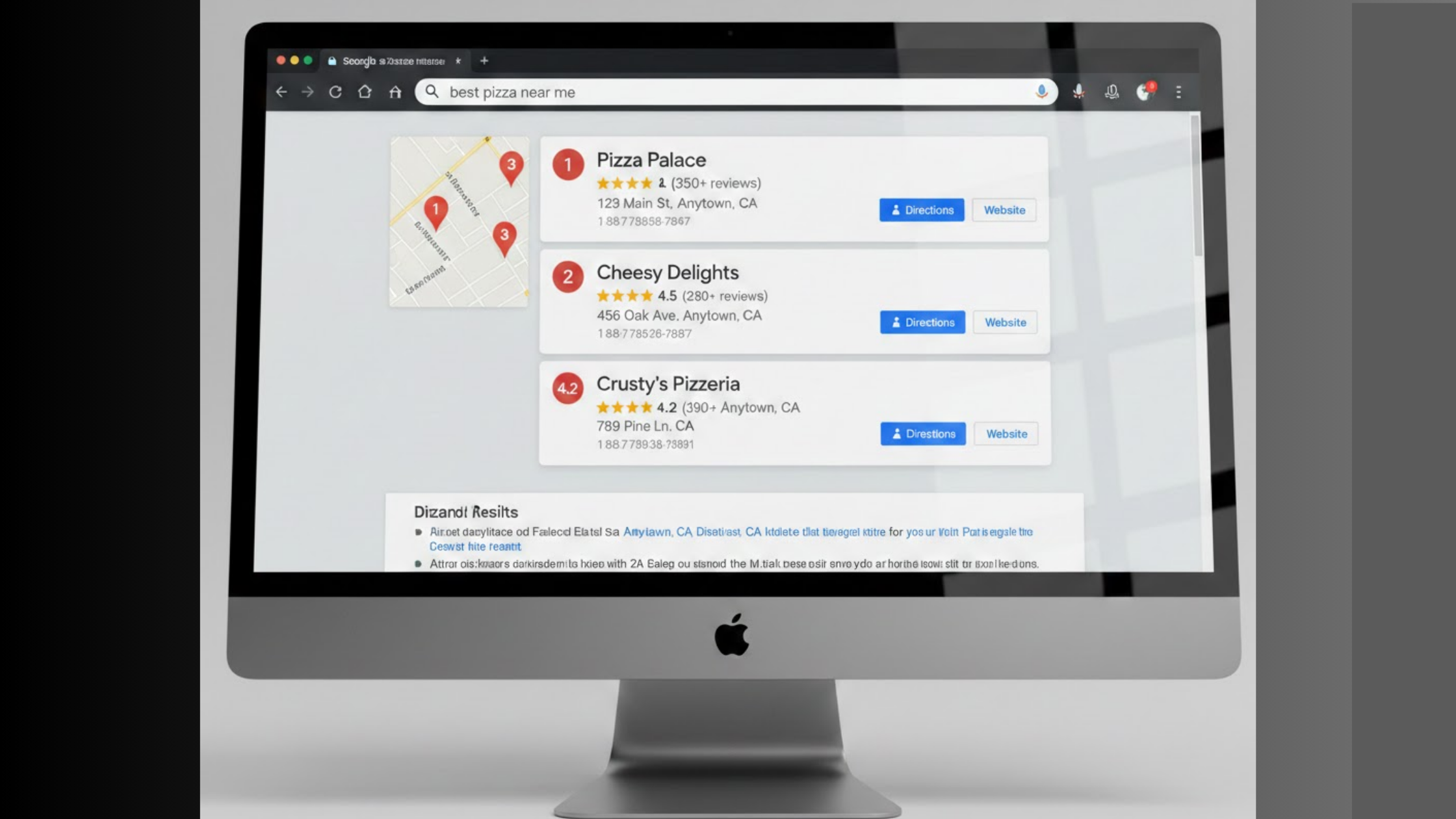
Your report should show whether you are in the top 3 local pack results. If you are not in the top 3 on Google Maps, most customers will not see you.
Localforce focuses heavily on helping you rank for these near me and area-specific searches. We help you track where you stand and give you suggestions on how to climb higher.
3) Review Analysis
Reviews are the social proof that makes or breaks a local business. Your report needs to show more than a star rating.
You should include:
- The total number of new reviews you got this month.
- The average star rating.
- Whether you are responding to reviews.
- What customers are saying (positive and negative trends).
Here is something interesting: If you respond to reviews, you build trust. And trust leads to more clicks. In your report, highlight how many reviews you replied to.
If you are using our AI tools inside Localforce to auto-reply or suggest replies, mention that. It saves time and keeps your brand sounding human.
4) Citation Consistency
Citations are mentions of your business Name, Address, and Phone number (NAP) on other websites.
If your NAP is inconsistent on the web, Google gets confused. And if Google is confused, you lose rankings.
A pro-level report includes a quick check on your top citations. Are you listed correctly on Apple Maps, Bing, and industry-specific directories? If not, that is a task for the next month.
With Localforce, we help you manage this across directories. We put GBP first because it’s most important, but we don’t ignore the rest.
5) Conversion Signals
This is what separates the pros from the amateurs. You need to track Conversion Signals.
What are those?
- Phone calls: Did someone pick up the phone?
- Direction requests: Did someone ask for driving directions?
- Website clicks: Did they visit your site?
- Bookings: Did they book an appointment directly from your profile?
If your report only shows impressions (how many people saw you) but not actions, you are missing the point. Business owners care about revenue. Actions lead to revenue.
At Localforce, we are obsessed with conversion signals. Our whole platform is designed to help you get more calls, more visits, and more bookings.
When you report on these, you are speaking the language of business owners.
6) Competitor Snapshot
Your clients or your team will always ask, “How are we doing compared to the guy down the street?”
You need a small section that shows:
- Where do you rank compared to the 2 or 3 main competitors?
- What they are doing that you are not (like posting more often or having more reviews).
How to Do Local SEO Reporting In 5 Steps
Now that you know what to include, how do you build this report without spending three days on it? Follow these simple steps.
Step 1: Define Your Goals Before You Collect Data
Before you open any tool, sit down and ask: “What is the goal for this location?”
Are you trying to get more phone calls? More foot traffic? More website bookings? Your goal determines what you highlight in the report.
For example, if the goal is calls, you will put the phone call metrics front and center. If the goal is foot traffic, you will focus on requests for directions.
At Localforce, we let you set up your dashboard based on what matters to you. You can track the metrics that align with your specific business goals.
Step 2: Gather Your Data from One Place

The old way of reporting meant logging into Google Business Profile, copying numbers into a spreadsheet, then logging into a rank tracker, and manually checking review sites. That takes forever.
The pro way is to use a tool that brings everything together. You want a single source of truth.
Localforce is that central hub. From our dashboard, you can:
- Audit your Google Business Profile health.
- See keyword rankings.
- Track competitor activity.
- Monitor reviews.
- Get suggestions on what to fix.
We do the gathering for you. You just log in and see the results.
Step 3: Compare Periods, Not Just Snapshots
Data is meaningless without comparison. Always show “this month vs. last month” or “this quarter vs. last quarter.”
If you had 100 calls last month and 120 this month, that is a win. If you had 100 calls last month and 80 this month, you need to explain why there was a difference.
Trends are better than single numbers. Localforce helps you visualize these trends so you can spot problems before they become disasters.
Step 4: Add Actionable Insights
This is the most important step. Tell the reader what the numbers mean and what to do next.
For example:
Amateur report: “Your calls decreased by 10%.”
Pro report: “Your calls decreased by 10%. We noticed that your competitor started running a special offer and posting more frequently. Next month, we will increase your posting frequency and add a special offer to your profile to compete.”
See the difference? One is just data. The other is a plan.
Localforce helps with this by giving you suggestions. It flags missing information on your profile, suggests keywords you aren’t ranking for, and even helps with AI-generated posts.
You can take those suggestions, apply them directly, and track the results.
Step 5: Keep the Design Clean
You don’t need a 50-page document. Nobody reads that. Keep your report clean, visual, and short.
Use charts for trends. Use big numbers for key metrics. Use bullet points for insights.
If you are an agency using Localforce, you can even use white-label reports. That means the report looks like it came from your agency, with your logo and your branding. It builds trust with your clients.
Tips for Local SEO Reporting

Know who you are talking to
A business owner just wants to know if they got more calls. A marketing manager might want the deeper data. Match your report to the person reading it.
Stop copy-pasting data
Don’t waste time entering numbers manually on a Sunday night. Use a tool to automate it. With Localforce, you can schedule reports or pull them instantly.
Celebrate the small stuff
SEO takes time. If you moved up a few spots in rankings or got a couple of new reviews, point it out. It proves you are building momentum.
Don’t hide the bad news
If rankings dropped, own it. Explain why (a Google update, a competitor move, or a profile error) and show your plan to fix it. Honesty builds trust.
Use a tool built for the job
Google’s free dashboard is fine for a quick look, but it isn’t enough for serious growth. You need a tool like Localforce.
We help you optimize your profile, track rankings, manage reviews, and report on it all in one place.
Conclusion
You now know what to include in your reports. Focus on your Google Business Profile performance, the right keywords, your reviews, and the actions that drive customer acquisition, such as calls and directions requests.
You also have a simple process to follow: set your goals, gather your data in one place, compare your progress, and always explain what the numbers mean.
The main thing to remember is that a report should lead to action. It should tell you what is working and what needs to be fixed.
If you are tired of jumping between different tools and copying data into spreadsheets, we can help.
Localforce brings everything into one simple dashboard. We help you track the essentials, find areas to improve, and manage your Google Business Profiles all in one place.