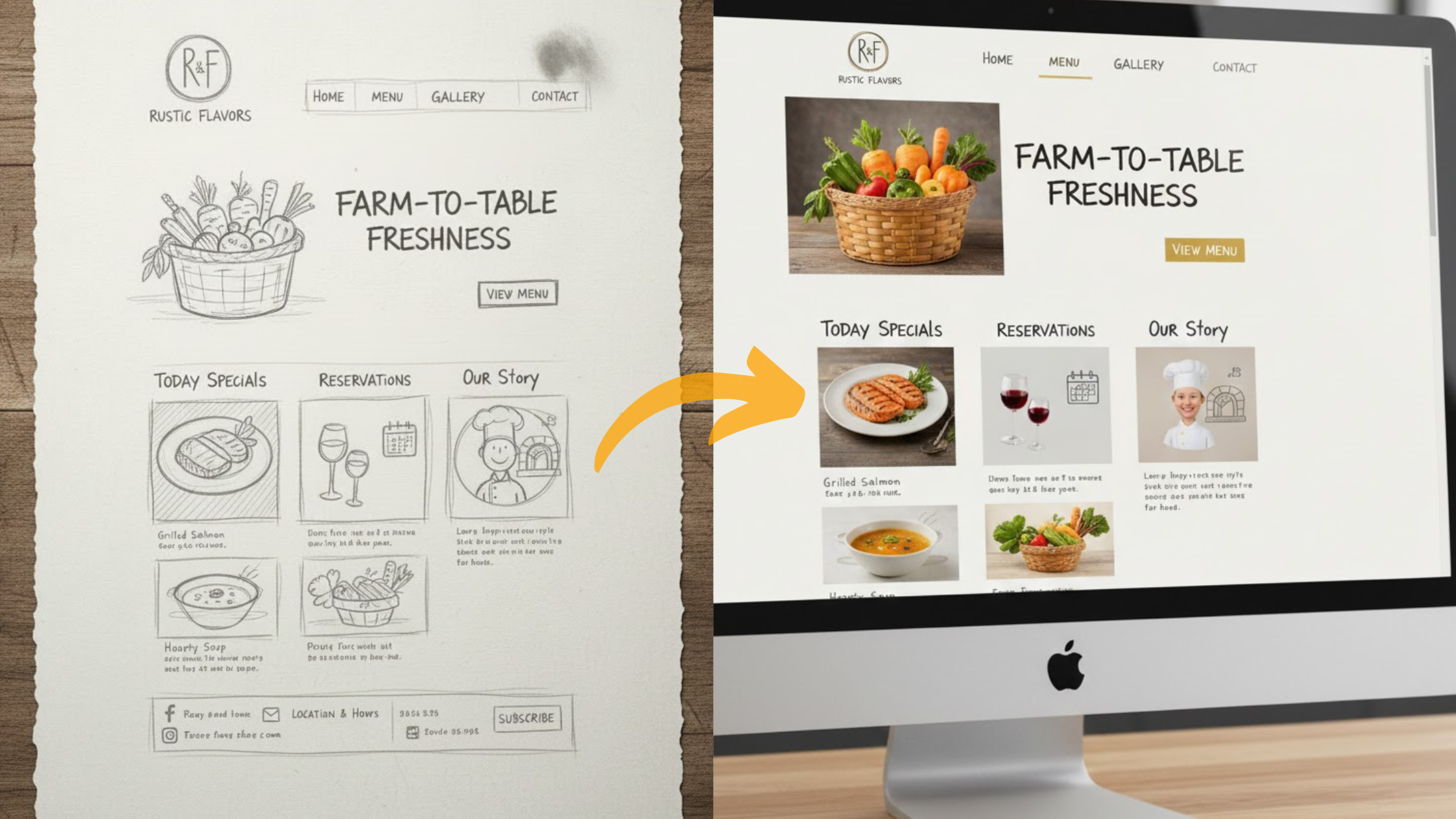

AI can only do so much for you. But have you ever asked yourself, can ChatGPT create a website?
ChatGPT is an everyday tool that can help you with any task. So, is creating a website among the tasks it can handle seamlessly?
If you want to build a website and use ChatGPT and are curious about its limits, this guide will explain what ChatGPT can do, how it works, and why you might prefer a simpler, all-in-one solution to get your ideas online.
Can ChatGPT Create a Website (Quick Answer)
ChatGPT can create a website, but not in the way you might think.
ChatGPT can generate HTML, CSS, and JavaScript code that forms a website’s skeleton, style, and functionality.
Take it as a situation where you are getting a car. ChatGPT can build the engine, but won’t provide the car or teach you how to drive it.
You are still in charge of:
- Planning the site’s structure
- Refining the AI’s output
- Testing for errors
- Handling the hosting and domain registration
Think of it less like a fully automated website builder like Wix or Squarespace and more like an incredibly talented, fast, and knowledgeable junior developer partner.
It writes the code you ask for, but you remain the project manager, architect, and quality assurance tester for the website you are creating.
While ChatGPT can help you create, the final responsibility for a functional, secure, and live website rests on your shoulders.
How Does ChatGPT Work In Website Creation?
Before we understand the role of ChatGPT in website creation, let’s learn what ChatGPT is.
ChatGPT is a large language model (LLM). It does not understand the world like a human.
Instead, it’s a pattern-matching engine trained on a massive dataset of text and code from the Internet.
So, how does it work?
Pattern Recognition
ChatGPT predicts the next most likely word, phrase, or line of code in a sequence based on its training.
For example, asking it to “write HTML for a landing page” does not determine what a landing page is.
Instead, it draws upon the many examples of landing page code it has seen during training and generates a statistically probable output that matches your request.
Contextual Awareness
ChatGPT also uses your ongoing conversation, the prompts, and previous responses as context to make its predictions more relevant.
Therefore, you can exchange back-and-forth messages to refine and correct the code it produces.
No True Understanding
When using ChatGPT to create a website, note that it doesn’t have an inherent knowledge of truth, logic, or the real-world consequences of its code.
Therefore, it can produce code that looks perfect but contains subtle bugs, security vulnerabilities, or outdated practices if its training data included them.
How To Create a Website Using ChatGPT
Are you thinking of using ChatGPT to create your new website? You can achieve this through prompting, refining, and integrating.
Here’s a detailed guide on how to use ChatGPT to create a website:
Planning and Prompting
Planning the goal you want to achieve from the website is critical to building a website with ChatGPT.
Know the structure, objectives, and desired features for your website. If you do not clearly define the website, you can ask ChatGPT to help create a plan.
This is also where you come up with sequential prompts for ChatGPT.
An example of your first prompt:
Generate the basic HTML5 boilerplate code for a professional photography portfolio website. It should include a header with a navigation menu (Home, Portfolio, About, Contact), a main content section, and a footer.
Generating and Assembling Components
You can request ChatGPT to generate the components piece by piece. In this step, your prompt can look like:
Write the HTML and CSS code for an image gallery grid within the main section. When clicking an image, it should be a 3-column layout with a lightbox effect.
Once ChatGPT generates a response, you must copy the code from each response and assemble it in your code editor, such as VS Code, into the correct files, such as index.html, style.css, and script.js.
Testing
Remember that we mentioned that ChatGPT is not perfect and draws from the numerous examples in its training database?
That is why testing is critical when creating a website using ChatGPT.
Do this to test and debug ChatGPT responses:
- Open your HTML file in a browser to see how it looks and functions.
- When something is broken or looks wrong, go back to ChatGPT. Paste the bad code and describe the problem.
An example Debugging Prompt: The CSS grid for my gallery isn’t creating three columns. Here is my current HTML and CSS code: [paste code]. What’s wrong and how do I fix it?
One advantage of ChatGPT during the testing step is that it explains errors and suggests fixes.
Deployment
This is where ChatGPT’s job ends.
You now have a folder with HTML, CSS, and JS files. The next step is making what you have a live website by:
- Purchasing a domain name from a credible registrar, such as Truehost or Namecheap
- Signing up for a web hosting service
- Uploading your project files to your hosting provider via their dashboard or FTP.
Pros of Using ChatGPT to Create a Website
ChatGPT is Fast and Efficient:
ChatGPT can generate large chunks of boilerplate code and standard components such as forms, nav bars, and footers in seconds, speeding up a website’s initial setup.
It is a Learning Tool
ChatGPT is an awesome tool for beginners who want to create websites. It is an ideal tutor.
You can ask it to explain complex code concepts in simple terms, learn new syntax, and understand why a particular bug occurred.
Idea Generation and Problem-Solving
ChatGPT is a good tool to help you understand complexities during website creation.
Stuck on how to implement a specific feature? Describe it to ChatGPT, and it will provide multiple approaches and code examples.
It is Cost-Effective for Simple Sites
For basic static websites such as portfolios, brochures, and event pages, ChatGPT can eliminate the need to hire a developer, saving significant money.
24/7 Availability
If you are a beginner and need a patient coding partner, ChatGPT is perfect.
It doesn’t get tired or frustrated with your questions; you can redo your website until you achieve the desired results without frustrating it.
Cons of Using ChatGPT to Create a Website
Lack of Originality
ChatGPT is not a designer. When creating a website, it replicates patterns from its training data, which can lead to generic, template-looking websites.
Also, ChatGPT cannot work out a unique design for your website.
Errors and Outdated Code
Even when creating a website, ChatGPT can hallucinate. It can generate good-looking but incorrect or non-existent code.
Its knowledge is also limited to its last training cut-off, so it may not use the latest frameworks or best practices when creating a website..
No Full-Stack Capability
While ChatGPT can write backend code in Python and Node.js, building a website with a database, user authentication, and server logic requires a deep architectural understanding beyond code generation.
Integrating these pieces is a complex human task.
Security Risks
ChatGPT can generate code with known vulnerabilities if its training data contains such examples. The risk is that it lacks the critical thinking to assess the security implications of the code it writes.
No Integration
When creating a website with ChatGPT, you are responsible for gluing all the generated code snippets, testing everything, and managing the hosting environment.
Hence, you cannot effectively build a website with ChatGPT if you do not have a foundational understanding of how websites work.
Tips for Using ChatGPT To Create a Website
- Plan your site structure on paper first and create a clear blueprint of what you want.
- Break down your requests into small, specific tasks. Ensure your prompts are specific and clear on what you need.
- Avoid ambiguous prompts like create a portfolio website
- Don’t just copy-paste code. Ask it to explain what each part of the generated code does.
- Always Test Thoroughly and do not assume the code is perfect. Test on multiple browsers and devices, then use ChatGPT to help you debug any issues.
- Use ChatGPT in conjunction with traditional website builders or established frameworks for design.
Olitt AI: The Better Alternative to Create a Website
While ChatGPT is a great tool for generating code, it leaves you with the heavy lifting of assembling, testing, and hosting.
If you want a fast, professional website without technical hassle, an AI website builder like Olitt is more efficient and is a better option.
In simple terms, ChatGPT gives you the lumber and tools to build a house, while Olitt gives you a pre-designed, move-in-ready house where you can just rearrange the furniture to your taste.
Here’s why Olitt is often the better choice for creating a website:
It’s All-in-One
Olitt handles everything in one place. You don’t need to manage separate code editors, hosting providers, or SSL certificates.
You get AI-generated design, global hosting, and security in one tool.
No-Code with Visual Editing
Olitt’s drag-and-drop editor lets you see your changes live. You can easily tweak designs, add buttons, and insert images by pointing and clicking; no code required.
This is perfect for beginners and those who want complete creative control without learning to program.
Launch in Minutes, Not Hours
You can describe your business, and Olitt will instantly create a complete, structured website with relevant text and a modern layout using its AI site generator.
This helps you bypass the tedious back-and-forth prompting needed with ChatGPT.
It’s Built for Business from the Start
Olitt comes with essential business features ready to go, including:
- E-commerce: Set up a simple online store with product pages and checkout.
- SEO Tools: Easily edit page titles and descriptions to help people find you on Google.
- Free SSL & Fast Hosting: Your site is secure, trusted by browsers, and loads quickly for visitors everywhere.
Conclusion
So, ChatGPT can create a website and generate the code, making it a knowledgeable assistant that significantly speeds up the development process.
However, it requires you to be the project manager, integrator, and tester, handling everything from structure and debugging to hosting and security.
Hence, ChatGPT is a tool for those with hands-on experience with the code.
For everyone else, entrepreneurs, small business owners, and creatives who want a professional and secure website without the technical headache, there’s a much smoother path: Olitt AI.
Instead of assembling the pieces yourself, you can choose an all-in-one solution to get you online effortlessly.
Launch your professional website today with Olitt.