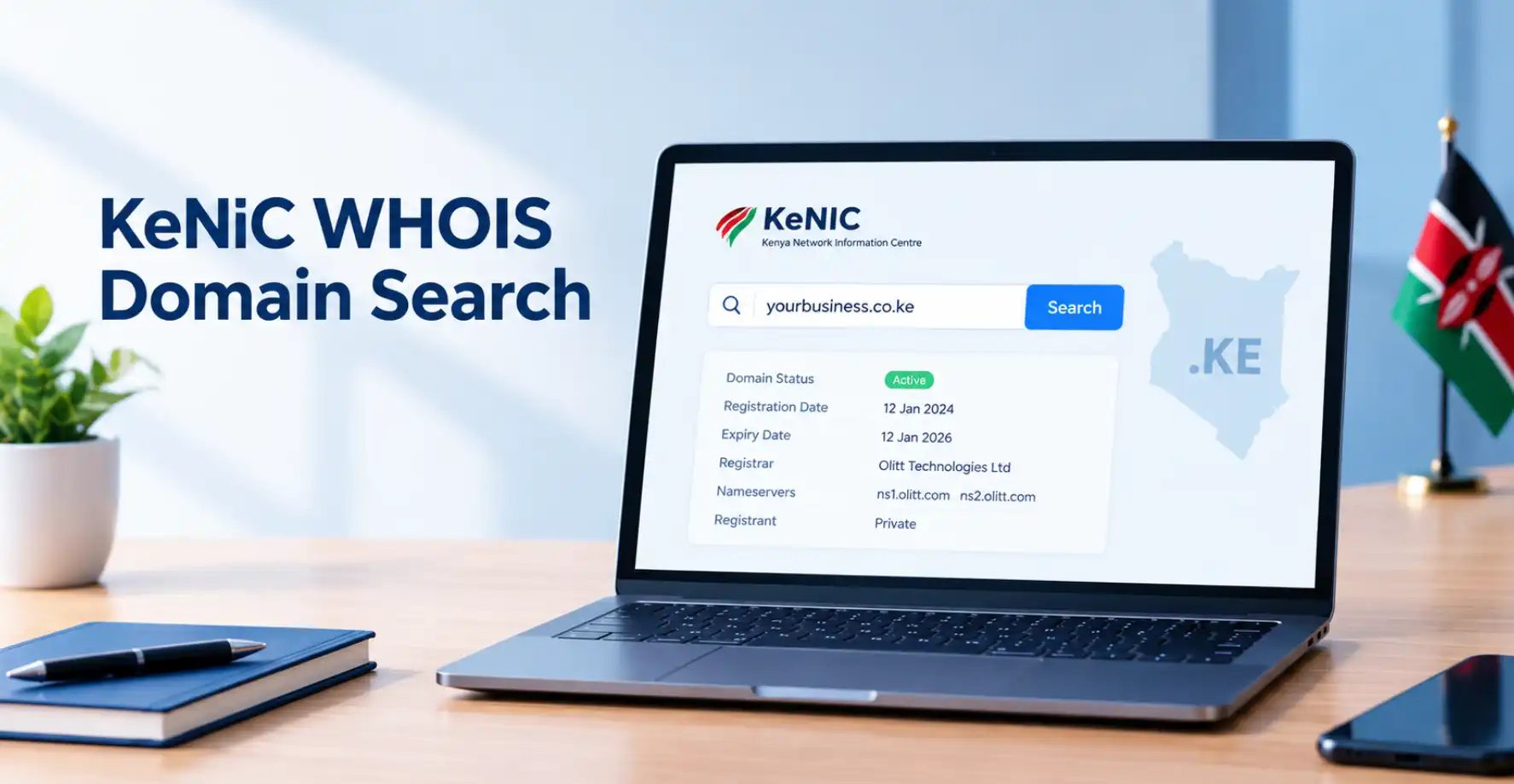

In this guide, you’ll find real ke domains examples used by leading Kenyan businesses, NGOs, schools, and government institutions.
Maybe you’re launching a Kenyan business, protecting your brand, or just curious about how major players use local domain names Kenya.
Either way, I’m giving you 14 concrete .ke domain examples that prove why this matters for your online presence.
KE Domain Examples (Quick List)
Here are real examples of active Kenyan domain names:
- safaricom.co.ke – Telecommunications
- jumia.co.ke – E-commerce
- equity.co.ke – Banking
- kcb.co.ke – Banking
- standardmedia.co.ke – Media
- nation.africa – Media (Kenya-focused)
- kenic.or.ke – Domain registry
- uonbi.ac.ke – University
- treasury.go.ke – Government
- tsc.go.ke – Teachers Service Commission
- hostafrica.ke – Web hosting
- truehost.co.ke – Web hosting
- kenya-airways.com/ke – Aviation
- huduma.go.ke – Government services
TL;DR: What You Need to Know About .KE Domains
Quick hits:
- .ke domain = Kenya’s country code top-level domain (ccTLD), managed by Kenya Network Information Centre (KENIC)
- Most popular: .co.ke (commercial), used by 90% of Kenyan businesses
- Other extensions: .or.ke (NGOs), .ac.ke (universities), .go.ke (government), .sc.ke (schools)
- Why it matters: Better local SEO Kenya, builds trust with Kenyan customers, protects your brand
- Cost: KES 399-1,200/year from domain registrars
- Registration: Available since 2017 at second-level (example.ke) or third-level (example.co.ke)
If you are doing business in Kenya, you need a .ke domain. Period.
Why .KE Domain Examples Matter (The Real Talk)
Here’s the deal: every day over 110,000 domains get registered globally.
The good names disappear fast. In Kenya, .ke domains give you a massive advantage:
a). Local SEO boost
Turns out, search engines prioritize local domains for Kenya searches. Your .co.ke ranks higher than a generic .com when Kenyans search.
b). Trust factor
Kenyan customers trust .ke websites more. It signals “we’re one of you” not “we’re international and might not deliver.”
c). Availability
Chances of getting your exact business name? 1:70 million for .com. But you’ve got 90% odds with Kenya domain name examples.
d). Protection
Lock down your brand before competitors or cybersquatters grab it.
Now let’s see who’s doing it right.
14 Popular .KE Domains Examples You Should Study
Commercial Domains (.co.ke)
1. Safaricom.co.ke
Kenya’s telecommunications giant. Over 14 million customers. They use .co.ke for their primary site while maintaining safaricom.com for regional reach.
Smart play: the .co.ke domain handles Kenyan-specific services like M-PESA while the .com serves their broader East African presence.
Lesson: Secure both .co.ke and .com if you’re scaling regionally.
2. Truehost.co.ke
Web hosting provider that walks the talk.
KENIC-accredited domain registrar offering .ke domains from KES 999.
We practice what we preach? – our entire business operates under .co.ke, demonstrating confidence in local domain infrastructure.
Lesson: Use the product you sell. It builds credibility.
3. Jumia.co.ke
E-commerce marketplace serving Kenya. They maintain country-specific domains across Africa (jumia.co.za, jumia.com.ng) but in Kenya, it’s .co.ke.
This localizes their offering and improves conversion rates with Kenyan shoppers.
Lesson: Localization wins in e-commerce.
4. EquityGroupHoldings.com/ke
Kenya’s second-largest bank uses a hybrid approach.
Main site is .com with Kenya-specific content under /ke subdirectory.
However, many Kenyan businesses reference them through equity.co.ke searches.
Lesson: Multiple approaches work, but .co.ke signals local commitment.
5. HostAfrica.ke
Domain registration and web hosting focused on African markets.
They secured the shorter .ke instead of .co.ke – possible since 2017 when KENIC opened second-level registrations.
Lesson: Shorter .ke domains are available and memorable.
Non-Profit Organizations (.or.ke) – Building Trust
Kenya Network Information Centre itself uses .or.ke. They manage all .ke domains on behalf of Kenyans. Using .or.ke reinforces their non-profit mandate and builds trust in the ecosystem.
Lesson: Use the right extension for your organization type.
7. KENET.or.ke
Kenya Education Network provides internet services to educational institutions. Their .or.ke status requires documentation proving non-profit status with KENIC, which adds legitimacy.
Lesson: Proper domain categorization enhances credibility.
Academic Institutions (.ac.ke) – Education Authority
8. Strathmore.edu
Wait – Strathmore University actually uses .edu, not .ac.ke. This is strategic. The .edu gives them international credibility while they maintain Kenyan presence through partnerships and local reputation.
However, most Kenyan universities use .ac.ke:
9. UoN.ac.ke (University of Nairobi)
Kenya’s largest university, serving 49,000+ students. The .ac.ke extension requires proof of educational institution status from Kenya’s Ministry of Education. This verification builds trust with prospective students and partners.
Lesson: Academic domains require documentation but carry weight.
Government Entities (.go.ke) – Official Presence
10. Government Ministry Websites
Examples like treasury.go.ke, health.go.ke demonstrate government digital presence. .go.ke domains require authorization letters from the Treasury, making them impossible to fake. This protects citizens from scam sites impersonating government services.
Lesson: Verified domains prevent fraud and build citizen trust.
Media & Content (.co.ke) – Audience Building
11. Nation.africa
Nation Media Group uses .africa for their pan-African presence, but historically they’ve used various .co.ke domains for Kenyan-specific content. This shows evolution in domain strategy as businesses scale across borders.
Lesson: Your domain strategy should evolve with your growth.
12. StandardMedia.co.ke
The Standard newspaper uses .co.ke for their Kenyan operations. Despite being a major media house, they stick with the .co.ke extension rather than going international with .com or .media.
Lesson: Local media benefits from local domains.
School Domains (.sc.ke) – Educational Credibility
13. Primary and Secondary Schools
Schools registered in Kenya use .sc.ke extensions. Like .ac.ke, these require supporting documentation from the Ministry of Education. This prevents fake educational institutions from operating online.
Lesson: Regulated domains protect students and parents.
Network Operators (.ne.ke) – Tech Infrastructure
14. ICT Companies and ISPs
The .ne.ke extension serves network operators and ICT companies in Kenya. It’s less common than .co.ke but specialized for the tech sector.
Lesson: Niche extensions exist for specific industries.
How to Choose Your .KE Domain (Action Steps)
Here’s your playbook:
1. Check availability immediately
- Use domain search tools from KENIC-accredited registrars
- Don’t wait – domains get registered daily
- Secure your brand name NOW
2. Pick the right extension
- Business? → .co.ke (commercial)
- NGO? → .or.ke (requires documentation)
- University? → .ac.ke (requires Ministry approval)
- School? → .sc.ke (requires Ministry approval)
- Government? → .go.ke (requires Treasury letter)
- Tech company? → .ne.ke (network) or .co.ke
3. Consider multiple domains
- Register .co.ke AND .com if scaling regionally
- Grab .ke (second-level) for shorter URLs
- Protect variations of your brand name
4. Choose a KENIC-accredited registrar Leading options with competitive pricing:
- Truehost Kenya (from KES 999)
- Kenya Web Experts
- SasaHost
- HostPinnacle
- OLITT (budget-friendly)
5. Bundle with web hosting Most Kenyan registrars offer:
- Free .co.ke with hosting packages (first year)
- Free SSL certificates
- DNS management
- Email hosting
6. Optimize for local SEO
- Use .ke domains for Kenya-targeted content
- Include Kenya-specific keywords in content
- List your business in Kenyan directories
- Get listed on Google Business Profile with .ke domain
Common Mistakes (Avoid These)
Mistake #1: Waiting too long.
Over 110,000 domains register daily globally. Your perfect name won’t wait.
You snooze, you lose!
Mistake #2: Only buying .com.
If you’re targeting Kenyan customers primarily, .co.ke outperforms .com in local search results.
Mistake #3: Wrong extension.
Using .co.ke when you’re a registered NGO? Get .or.ke for credibility.
Mistake #4: No brand protection.
Not securing variations lets competitors or cybersquatters grab them.
Mistake #5: Ignoring documentation requirements
.ac.ke, .sc.ke, and .go.ke need supporting documents. Plan accordingly.
Registration Requirements You Must Know
Basic .co.ke registration:
- Available to individuals and businesses
- Presence in Kenya required (but not citizenship)
- Valid contact information
- First-come, first-served basis
Specialized extensions:
- .or.ke: Non-profit documentation
- .ac.ke: Educational institution proof from Ministry
- .sc.ke: School registration from Ministry
- .go.ke: Treasury authorization letter
Registration period:
- 1-5 years available
- Annual renewal required
- Auto-renewal options from most registrars
- Transfer possible between KENIC-accredited registrars
The Cost Reality (2025 Pricing)
Based on market research:
.co.ke domains: KES 399-1,200/year
- OLITT: Most affordable
- Truehost: KES 999 (competitive)
- International registrars: $30-100/year
Additional costs:
- WHOIS privacy: KES 400/year (optional)
- SSL certificate: Free with most hosts
- Email hosting: KES 150-500/month
- Web hosting: KES 100-5,000/month (depends on needs)
Free options?
Some registrars include free .co.ke domain with annual hosting plans.
Your Next Steps (Do This Today)
- Search your business name on KENIC-accredited registrar sites
- Register immediately if available (seriously, stop reading and do this)
- Purchase .co.ke + .com if available and budget allows
- Set up professional email using your new domain ([email protected])
- Launch your website with proper web hosting
- Claim your brand on social media with matching handles
- Set up Google Business Profile with your .ke domain
FAQs
What is a .KE domain?
A .KE domain is Kenya’s official country-code domain extension. It includes extensions like .ke, .co.ke, .or.ke, .ac.ke, and .go.ke, each serving different types of websites.
What are some examples of .KE domains?
Examples include safaricom.co.ke, jumia.co.ke, treasury.go.ke, uonbi.ac.ke, and kenic.or.ke, showing how businesses, schools, and government institutions use Kenyan domains.
Which .KE domain should I choose?
Choose .co.ke for a business, .ke for a premium brand, .or.ke for a non-profit, .ac.ke for an educational institution, and .go.ke for a government organization.
Are .KE domains good for SEO?
Yes. A .KE domain helps signal that your website targets users in Kenya, making it a strong choice for businesses focused on the Kenyan market.
Where can I register a .KE domain?
You can register a .KE domain through trusted registrars such as Olitt, Truehost, HostPinnacle, and other KENIC-accredited providers.
Final Word
These 14 Kenyan website addresses prove one thing: .ke domains aren’t optional for serious businesses in Kenya. They’re necessary.
Safaricom, Equity Bank, Jumia, Nation Media – they all use local domain names Kenya because it works. Better local SEO. More trust. Higher conversions.
The examples of Kenyan domains in this post show different strategies – some use .co.ke exclusively, others combine with .com, but they all recognize the value of .ke domain usage in the Kenyan market.
Your competition is reading this too. The difference? You’re going to act on it today.
Action beats theory every time.
Now go register your .ke domain before someone else does.
Ready to Get Your .KE Domain?
The examples above show how Kenyan businesses, organizations, schools, and government institutions use .KE domains to build a strong local online presence.
If you’re ready to secure your own .KE or .co.ke domain, Olitt gives you a simple and budget-friendly way to get started. Search for your preferred domain name, check its availability, and register it before someone else takes it.
Find your perfect .KE domain with Olitt and start building your Kenyan online presence today.

Read also: