
Knowing when not to use a .org domain is just as important as understanding when it’s the perfect choice.
So, before you grab that shiny new .org domain, let’s pause for a second.
Yes, .org is trusted. Yes, it looks serious and credible. But here’s the thing, it’s not always the right fit.
It is a powerful tool, but only when it matches your purpose.
Truth is, while it’s ideal for nonprofits, communities, and mission-driven projects, there are situations where it simply doesn’t align with your goals.
Sometimes even, using the .org can actually confuse your audience or work against what you’re trying to build.
A wrong domain can affect how people perceive your brand from the very first click.
Let’s walk through the scenarios where a .org might not be the best choice, so you can make a confident decision.
Here’s what we’ll cover:
- The top six situations where .org spells trouble for your bottom line
- Hidden risks and steps to dodge them
- Our handpicked alternatives, to get you started today
Let’s arm you with the clarity to choose right and avoid the regret.
Why .Org Feels Right… Until It Doesn’t
At first glance, .org just feels good.
I mean, it’s been around since 1985 and carries a strong nonprofit, do-good reputation.
Think of organizations like the Red Cross (redcross.org). Seeing a .org instantly signals trust, purpose, and credibility.
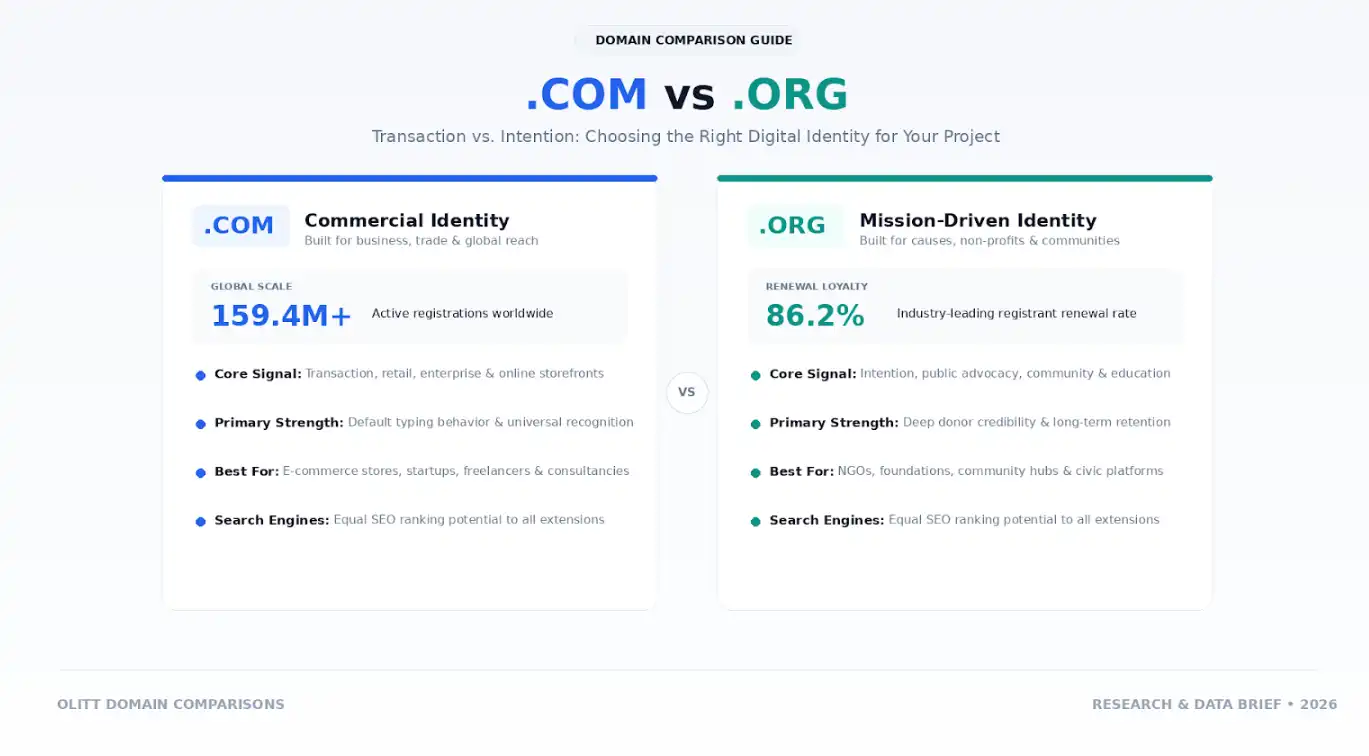
But here’s where things get tricky. That same nonprofit aura can work against you if your site is built to sell something.
Technically, ICANN, the organization that manages domain names, never restricted .org to nonprofits.

Anyone can use it.
But again perception matters, and people haven’t let go of the old association.
So what happens when your site is actually commercial? Visitors may hesitate before they even click.
If your goal is transactional a .org can quietly create confusion right from the URL bar.
People may wonder, “Am I about to donate… or buy?”
Search behavior reinforces this too. When someone Googles something like “buy running shoes,” Google tends to favor .com domains because they align with shopping intent.
A .org, on the other hand, is more likely to show up alongside informational or educational results, which can seriously hurt click-through rates.
So, it’s not that .org is bad. It’s only that it’s not always the right fit.
Knowing when not to use .org can save you lost clicks, confused visitors, and missed revenue.
Next, let’s look at the exact scenarios where choosing .org doesn’t work.
When Not to Use .Org: The Top Scenarios to Sidestep
Since we now know there are times when a .org domain can actually cost you traffic, trust, and even sales, what are they exactly?
1) E-Commerce Stores Looking for Quick Sales
If you’re selling anything online, be it clothes, gadgets, or handmade goodies, .org is usually not your friend.
Shoppers expect .com for buying; .org feels like a donation site, not a store.
Data backs it up: .com domains get 15–20% higher click-through rates and trust scores for shops are roughly 25% higher than other TLDs.
Smarter Swap: Grab a .com at Olitt for $8.50 your first year (WHOIS privacy included), renewing around $12–15.
If you want something niche, try .shop, starting at $2.99 for the first year. Pair it with an SSL bundle for $1 and launch without the trust tax.
Check your domain on Olitt and see what’s available.
2) Tech Startups Chasing Investor Buzz
If you’re building a SaaS or an app, .org can actually make you look… old-school.
Investors and users judge a URL in a glance, and if your domain screams nonprofit instead of disruptive startup, you might get passed over.
Smarter Swap: Consider .io (tech vibes, $38.52 first year with free DNS setup) or .app ($18.36).

Both renew similarly and Olitt charges reasonable transfer fees if you switch.
Run a quick audit on your current setup with our free tool, snag your .io or .app, and watch B2B leads flow faster.
3) Personal Brands Building Follower Loyalty
Are you an influencer, coach, or freelancer trying to grow a personal brand?
Then let’s be honest, .org probably isn’t doing you any favors.
It feels a bit too formal, almost like you’re running an institution instead of building a one-to-one connection.
People don’t follow personal brands because they feel official.
They follow them because they feel human. Friendly. Approachable. Like someone they’d actually want to learn from.
Now, .com still feels professional, but not cold. It signals, “I know what I’m doing,” without creating distance.
Even better options for personal brands:
- .me (available at Olitt for $9.40 in the first year, with free privacy), perfect if you’re a solo creator
- .co ($12.76) — great if you want a modern, global feel
These are simple, personal, and unmistakably you.
4) Local Services: Winning Neighborhood Clients
If you run a local business, like a plumber, café, salon, or repair shop, this is you part.
When people search “near me,” they’re expecting something familiar and local.
A .org domain often sends the wrong signal, making your business sound like a nonprofit or community organization instead of a service they can call today.
On the other side, familiar domains build instant trust, and local SEO rewards them.
Smarter domain choices for local businesses:
- .com (around $8.50 for the first year)
- .biz (about $10.99 at Olitt—worth checking availability)
- Country domains like .ke for Kenyan businesses ($15–$20), which help signal local relevance
The goal is simple: look familiar, feel local, and show up where your customers are already searching.
5) Creative Portfolios That Show You, Not a Committee
If you’re an artist, designer, or writer, .org probably isn’t your vibe, and it feels formal and institutional.
But creative work needs personality. It needs energy. It needs spark.
Now, creative-focused domains don’t just look better, they signal originality before someone even sees your work.
Smarter swap:
Go for .art (around $3) or .design (about $50). Platforms like Olitt often offer great first-year deals, plus free transfers.

6) Regulated Fields Like Finance or Health
Now, if you work in finance, health, or law, .org can also quietly work against you.
These industries run on trust, compliance, and credibility.
A .org domain can feel a little too informal, or worse, raise red flags during audits.
Specialized TLDs feel intentional, and regulators tend to trust what feels purpose-built.
Smarter swap:
- .finance (around $13) or .health (around $72)
- Or start simple with .com (from $8.50) and layer in compliance tools
The Risks: What Happens If You Still Use .Org Domain Wrongly?
You already know the scenarios. Now let’s talk about what actually happens when things go wrong.
When choosing to use .org, despite the warning, the risks usually show up in three quiet but costly ways: people trust you less, your SEO takes a hit, and your brand gets fuzzy.
1. Let’s start with trust.
People carry assumptions online, whether we like it or not.
A .org domain signals “nonprofit” or “cause-driven.”
When visitors land on a commercial site with a .org, many hesitate for a split second: “Wait… is this legit?”
That pause matters. E-commerce data shows .org sites convert 10–15% worse than .com for this reason alone.
2. Next up: SEO.
Google won’t punish you just for using a .org, there’s no secret penalty or manual action lurking.
But search intent is still of importance. Transactional searches naturally favor .com, while .org leans informational.
When those signals don’t line up, rankings suffer.
3. Then there’s your brand.
.Org is just crowded. According to PIR, there were 11 million .org domains in 2024.
That’s fantastic for charities and community groups, but for businesses it can make your brand harder to remember and easier to blend into the background.
Wrapping It Up
And now you know when not to use org.
It hits hardest for e-com, tech, personal, local, creative, and regulated plays.
Remember: .org shines for true non-profits, but for your growth, .com or kin keeps risks low and rewards high.
You’re steps from a domain that works for you.
Head to Olitt, punch in your idea, and lock it down. Chat us, we’re here to make it painless. Your thriving site starts now.